

A few months ago I had to “help” my son build a Pinewood Derby car for his Cub Scout troop. I use the word “help” loosely because I built the entire car and he put the stickers on it. Nevertheless, core memories were created.
Anyways, I was completely out of my element. I’m not a crafty guy. Not a handyman. I don’t own any kind of power saw. I was lost. I watched a bunch of YouTube videos, read some how-to blog posts, and in the end I was nowhere closer to being qualified to build him a good car. I did my best, though.

Expert advice shouldn’t only be for experts
The issue was that at some point around the 30-second mark of each tutorial some kind of jargon was used I had never heard before. Or some type of tool was being used that I’d never seen before, let alone owned. Insert facepalm emoji.
This is probably how a lot of business owners feel about trying to do SEO. Every post or video is saturated with terms, abbreviations, and tool mentions that mean nothing to you. You’re not a marketer.
So in this post, I’m going to attempt to decode SEO in 2026 in a way that is meaningful to anyone, not just people who obsess over algorithms for a living.
If you’ve been exposed to any amount of SEO “content,” you probably think that there’s only one route to true SEO growth: spend all your free time writing as many blog posts as you can!
Please. Stop. Believing. That.
Just write a ton of blogs, right?
Think about it from Google’s perspective for a second. Why would they want more content to comb through? That just makes their job harder. Google isn’t looking for more. They’re looking for better.
One piece of content with real, thorough coverage of a topic will smash a hundred thin blog posts every time. I’ve seen it happen. You’d honestly be better off publishing one genuinely useful piece a year than a fluff post every week. And that’s not hyperbole.
The reason no one else is telling you this is pretty simple. Agencies need hours to bill. The more content they convince you is necessary, the more you need them. And when one of those twenty-five posts finally happens to get some traction, they’ll tell you it’s working and you’ve got to keep going. It works out well when you’re the one charging for it.
The actual move is a lot simpler. Start with the one idea your audience needs to understand better. Write something so useful they bookmark it, save it to their notes app, send it to a friend, share it on social media. Boom. You just became valuable to them even though they’ve never spent a single dollar on what you’re offering. That matters to them. And Google notices.
There’s also a toxic SEO pattern I call the one-and-done fallacy. A business sees early progress, rankings improve or traffic spikes, and they assume the momentum will just naturally keep going. At that point, the work slows down or stops altogether. Oof. Performance doesn’t just plateau. It plummets off the side of the cliff. SEO momentum isn’t a snowball you push once and walk away to watch the avalanche. When you stop applying pressure, those gains will hemorrhage out before you even notice it.
This can lead to an even more damaging (to your wallet) assumption that more activity automatically equals better SEO. Thin, redundant, or low-value website content can actually dilute your authority and weaken the overall site in Google’s eyes.
This is why a clean, focused, well-maintained website will almost always outperform a larger site that’s trying to do too much. It’s quality over quantity. Both require effort, but only one is rewarded by Google.
The one principle that guides everything I do
If I had to reduce my entire SEO philosophy to one idea, it would be this: a website has to be useful.
Useful Website 101:
✅ Easy to navigate.
✅ Clearly designed.
✅ Honest about what it offers.
✅ Focused on answering real questions.
✅ Built to help users take the next step.
That’s it. Good SEO isn’t about tricks or hyper-activity. It’s about building something that actually deserves to rank.
Before I touch anything on a client’s website, I spend time making sure we’re on the same page about what SEO is and what it isn’t. What realistic progress looks like. What timelines actually look like. This part isn’t glamorous, but it matters more than anything else I do.
SEO only helps the bottom line when it’s aligned with how the business actually operates, and that requires getting honest about expectations upfront.
Once that foundation is set, the first hands-on work I start with is metadata. I know, I know. Just stay with me.
What is metadata for SEO?
Metadata is the introduction to every page on a website. The title tag and meta description tell search engines and real people what a page is about before they ever click on it. I treat metadata as a diagnostic tool more than anything else. If I can’t clearly describe the purpose of a page in a title and a brief description, that’s usually a clear sign the page itself isn’t very useful. The metadata audit process helps me figure out which pages are worth investing in and which ones need to be trimmed, consolidated, or given the boot.
Here’s what it looks like:
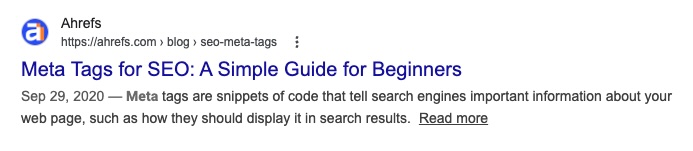
(Oh, and yes, “meta tags” and “metadata” refer to the same thing because its complicated for no reason and I don’t make the rules.) 🙄
But backlinks are uber important for SEO, right?
Buckle up. One thing I deprioritize almost immediately is backlinks. They’re buzzworthy and hard to ignore, but there’s very little you can do to directly control high-quality backlinks in a sustainable way.
Chasing them too early usually turns you into a “quick fix” mentality. It’s like paying people to leave glowing reviews for a book that isn’t very good. You might get someone to pick it up, but they won’t finish it, recommend it, or come back for your next one.
Early in my career I leaned on backlinks more than I should have because they were an easy win to point to. Also, all the other experts were raving about them, so it had to be important, right? Experience eventually taught me that sustainable SEO isn’t about exploiting gaps. It’s about building something that actually deserves to rank.
How I decide what to work on
Every time I begin SEO with a new client I start with an audit. It’s my most popular project offering, but more importantly it’s the most useful one. Without it I’m just literally guessing. If you had a previous SEO consultant that didn’t start with an audit, I’d be interested to see what the heck they based their strategy on. Just saying.
What does a good SEO audit look at?
An audit gives me a real picture of how a website is performing, not how it looks on the surface. I’m looking at things like:
- Which keywords the site already ranks for and which pages are driving that traffic
- Technical health: broken links, load speed, crawl issues, schema markup
- How the site looks and functions on mobile
- Design, usability, and whether the experience actually makes sense for a real visitor
Once I understand that landscape, I peek into Google Search Console for some more context. At first, I just focus on the last 90 days of data. I’m not hunting for anomalies or one-off spikes. I’m looking for real patterns.
The pages that grab my attention first are the ones with high impressions and low clicks. These pages are fascinating in a slightly frustrating way. Google is already surfacing them in search results. Users are seeing them. But nobody’s clicking. Something is off.
The tell-tale signal: Low Click Through Rate (CTR)
A page that needs some TLC usually has one of a few problems:
- The title or meta description isn’t giving people a reason to click
- The page is showing up for searches it doesn’t actually answer (intent mismatch)
- Competing results are positioned better and present more clearly
- The framing of the page just flat out needs work
I think of these pages like a book sitting on a shelf in a busy bookstore. People walk past it every day and nobody picks it up. That has nothing to do with the words on the pages inside. That’s a cover problem. Fix the cover. (Moral of the story: people CAN and DO judge books by their cover. Also websites.)
A page is worth working on when two things are true: the topic is genuinely useful and deserves more visibility, and the page already shows signs of potential through existing impressions or rankings.
That gap between visibility and engagement is where the most meaningful SEO improvements can happen. Fertile SEO soil. 🌱
Why I don’t start with blogs, keywords, or tools
Ok so this comes up a lot, and I want to be direct about it.
I don’t start SEO with blogging because blogs are not the foundation of a good website. They’re the branches. The foundation is your homepage and core service pages. Those pages carry the weight of authority and do the heavy lifting in search.
Blog posts only work when they support useful foundational pages. A strong appendix doesn’t save a weak book. Get the book right first.
I know. Lots of book references for some reason. I think it’s because I’m trying to read more this year. Anyways, I digress.
The outdated art of keywords
I also don’t start with keywords in the traditional sense. Before you report me to the SEO police, I realize that they do still matter, but treating them as the whole strategy is wildly outdated. Let’s just say that last time that was even remotely effective, I had a full head of thick hair and a fully dark beard.
Why doesn’t it matter like it used to? Because people just don’t search with one or two words anymore. They search with questions, problems, and even full scenarios thanks to AI.
SEO today is less about chasing isolated terms and more about understanding why someone is searching and what would actually help them. That’s usually a human judgment call, not a SEO tool output.
But if I just had the right SEO tool…
Which brings me to tools. The things I didn’t have when I was trying to build the fastest Pinewood Derby car for my little guy. They’re useful for research and validation, sure. I use them constantly. But tools can’t replace judgment. An algorithm can surface data, but it can’t fully understand your business, your customers, or why someone chooses you over a competitor. That part requires human empathy. No tool replicates that (yet?).
What Google is actually paying attention to
Google’s goal is simple: serve the most satisfying results so users keep coming back. Google is a business. They offer relevance. The way they stay useful is by tracking behaviors.
Do people click your result? ✅
Do they stay on the page? ✅
Do they engage with it? ✅
or…
Do they bounce straight back to the search results? ❌
Those behaviors are the real signals. If a page is confusing, slow, cluttered, or not what the user expected, they peace out. Google sees that and takes note.
That’s why I always look at the homepage and core service pages first, before anything else. You can have the right keywords and technically correct SEO, but if the page itself doesn’t fully answer the intent behind the search, it just won’t perform. No matter how many times you put a keyword in the headers. Sorry.
This is also why so many businesses ultimately decide that SEO just doesn’t work for them. The site may have been optimized, lots of content added, backlinks built. But the foundation was never solid. Pages are hard to use. Things look “meh” on mobile. A pop-up interrupts before the visitor has even had a chance to read anything. When that’s the user experience, attention drops, and Google isn’t about to reward that with better rankings.
The burning question: But what about AI???
One question I get constantly: does SEO even matter in 2026 with AI changing everything about? Short answer: Yes. But only when it’s focused on usefulness, intent, and user experience. Contrary to what every Marketing Influencer says on LinkedIn, AI has not replaced SEO. But it is raising the bar for what deserves visibility. More on that in a later post. Stay tuned.
What my clients are actually paying me for
To start with, clients hire me to improve their visibility on Google. Simple. Search results are a storefront window. The businesses that appear front and center get the attention, the clicks, the calls, and the sales. Most of my clients know they should be there. They just don’t know why they aren’t or what it will take to change that. They pay me to figure that out.
Once the overall visibility improves, the work shifts to protecting and building on that new store window positioning.
SEO changes quietly. Algorithms shift. Competitors adjust. User behavior evolves. Someone has to be paying attention to those changes and knowing which ones actually require action. You see, that’s the judgment part of this job, and it’s the part that takes years to develop. And unfortunately, an AI tool or automated process can’t do it.
Ultimately, what clients are paying for is experience and clear judgment applied consistently to their website over time. More visibility means more opportunities to earn trust, generate leads, and grow their business. Everything else is just how we get there.
SEO takes time. If you’re looking for a quick fix or instant leads, I’m genuinely not your person. No hard feelings. But if you understand that showing up better on Google is good for your business and you’re willing to do this the right way, I’d love to help.